

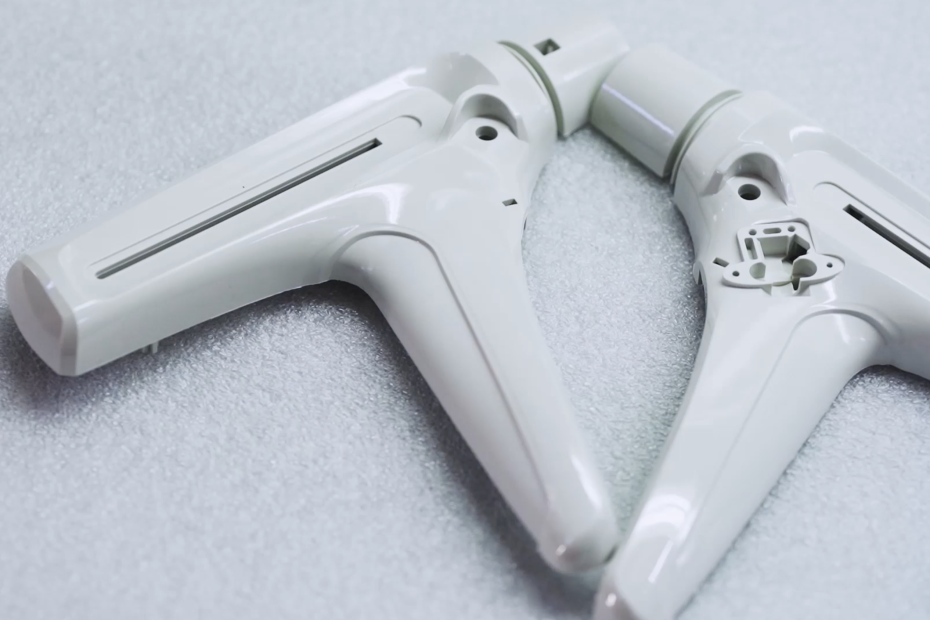
Poor surface finish or mismatched tolerances are among the most common reasons parts fail quality control checks. This causes production slow downs, delayed product validation, and introduces unnecessary risk, especially in regulated sectors such as medical devices and electronics.
What makes these problems worse is that they’re often avoidable. The solution starts with early DFM and clear supplier communication.
Hidden Cost #1: Unclear Surface Finish Standards
One of the most common issues Wanox sees is when customers label drawings with vague descriptors like “high-gloss” or “matte” but don’t specify measurable finish grades such as the Society of the Plastics Industry (SPI) or the Verein Deutscher Ingenieure (VDI). Without a defined standard, each party has a different expectation of what the part should look like, and by the time a mismatch is discovered, the mold might already be processed.
In one case, a customer specified SPI A-1 high-gloss polish across the entire cavity of a transparent part. That requirement, while understandable for visual clarity, clashed with the part’s complex geometry. Ribs and internal features made it nearly impossible to apply a uniform A-1 finish, and the machining time and cost soared.
Wanox engineers suggested a smarter split: keep the A-1 finish for functional surfaces, while relaxing the standard to SPI B-1 or C-1 for non-functional ribs and internal posts.
The result? A part that met both performance and appearance goals without breaking the budget or timeline.
Wanox’s approach starts during the quotation stage by asking clients:

1. Is there a finish standard required (SPI, VDI, Mold-Tech (MT), etc.)?
2. Are physical samples available for reference?
3. What’s the final application of the part?
4. By gathering this detail early, rework and project creep are significantly reduced.
Hidden Cost #2: Over-Tolerancing (or No Tolerancing at All)
Buyers often transfer drawings from metal to plastic parts without adapting the tolerance strategy. This leads to over-engineering as tiny tolerances that drive up mold complexity and cost. Or, on the other end of the spectrum, vague dimensions that leave too much to interpretation.
Wanox frequently sees international customers apply tight metal-based tolerances to plastic parts, often without considering material flexibility or shrinkage. That approach wastes money and also increases the likelihood of rework when the part fails to fit or function as expected.
To prevent this, Wanox actively asks about mating parts and assembly relationships during DFM reviews. If customers can define how the part fits into the final product, the team can pinpoint which 3–5 dimensions actually matter. These become the “critical-to-function” tolerances. Everything else gets optimised for manufacturing.
When tolerances are unclear or inconsistent, they affect tool design, mold cooling, and even venting. Wanox uses mold analysis software to simulate deformation in advance, especially for thin-wall or multi-material designs. This reduces guesswork and protects project timelines.
Hidden Cost #3: Tooling Mismatch with Part Requirements
Surface finish and tolerances depend on tooling decisions that many buyers overlook. The type of steel, insert design, and polishing method all affect quality—and cost.
For example, high-gloss transparent parts require high-purity steel such as S136, which can be mirror-polished and resists corrosion. On the other hand, textured parts can use more common steels, such as 1.2344. Wanox helped a medical device customer reduce rejection rates by switching from a non-polishable steel in the prototype mold to S136 for the production tool. The change brought the part’s appearance in line with industry expectations.
Without this kind of guidance, buyers risk choosing materials or machining processes that are incompatible with the finish or tolerances they want. That leads to rejected parts, expensive mold rework, and production delays.
The DFM Advantage: Prevention Beats Fixes

Some buyers see DFM as just another line item before tooling. But when done correctly, it prevents failure points before they happen. Wanox’s DFM process includes:
• Manufacturability Analysis: Identifies unpolishable areas or sharp corners that can cause surface defects.
• Draft Analysis: Ensures all side walls have enough draft to eject cleanly.
• Parting Line Optimization: Places the parting line for minimal visual or functional disruption.
• Gate and Vent Analysis: Prevents issues like flow marks and air traps.
• Tolerance Simulation: Uses software to predict deformation and guide tool design.
Every DFM report includes annotated drawings and recommendations so customers understand exactly which changes will improve quality, reduce costs, and shorten lead times. This is front-line protection against surprises.
What Good Suppliers Ask Before Quoting
To do this well, suppliers need to ask the right questions up front. Wanox uses a standard checklist that covers:
• Aesthetic Grades: Grade A (visible), B (secondary visible), and C (non-visible) areas.
• Finish Standards: SPI, VDI, or EDM grades mapped to specific surfaces.
• Critical Dimensions: Usually 3–5 tolerances that affect assembly or function.
• General Tolerances: Whether to apply ISO 2768-m or a customer-specific standard.
• Post-Processing: Whether painting, plating, or welding will be applied.
• Assembly Context: Any CAD models of adjacent parts that affect the interface or clearance.
• Quality Standards: What inspection criteria or testing will be used?
Wanox reports that about 60% of international clients don’t have this information fully defined at the start. That’s not a problem because that’s where their value comes in. The team collaborates with customers, especially those new to injection molding or scaling from prototypes to production. The goal is to build the mold with consistent, validated parts from day one.
Final Takeaway
Poor surface finish and tolerance issues are not mysteries. They are signals that the right questions weren’t asked early enough.
By partnering with a supplier who understands where the risks lie and how to mitigate them, buyers protect both their production timelines and their reputations.
Concerned about rejection rates from poor finish or tolerance mismatches?
Contact us and let us help you avoid the root causes through DFM-first tooling and transparent communication.


